 HSA & FSA accepted; best-value for top quality care
 Same-day mental health, weight loss, and primary care appointments available

 Accept major insurances and cash-payHSA & FSA accepted; best-value for top quality careSame-day mental health, weight loss, and primary care appointments availableAccept major insurances and cash-pay
Your Telehealth Mental Health First Visit: What to Expect
Written by Klarity Editorial Team
Published: Jun 18, 2026

A telehealth mental health first visit is a secure video session that connects you to a licensed mental health professional, including MDs, nurse practitioners, and therapists, from your own home. Knowing what to expect before you log on removes the guesswork and lets you focus on what actually matters: getting support. Your initial telehealth consultation covers intake questions, confidentiality policies, and treatment goals rather than deep therapeutic work. Session fees for uninsured patients typically range from $100 to $225, and most platforms accept Medicare, Medicaid, and major insurance plans. This guide walks you through every step so your first time feels manageable, not intimidating.
What does a telehealth mental health first visit actually cover?
Your first virtual mental health appointment is an intake session, not a therapy session in the traditional sense. The distinction matters. Your provider uses this time to understand who you are, what brought you in, and what you hope to achieve. Think of it as a structured conversation rather than a deep dive into your history.
First appointments typically last 45–60 minutes, though comprehensive evaluations can run up to 80 minutes. That time is well spent. Your provider will cover introductions, walk through confidentiality policies, review your medical and mental health history, and discuss your current symptoms and goals.

Therapists often open with questions like “What brings you to therapy now?” or “What do you hope to achieve?” These open-ended questions are designed to start a conversation, not demand a polished answer. You do not need a detailed plan. A general sense of what you are struggling with is enough to begin.
Confidentiality is also addressed directly in this first session. Your provider will explain the legal limits of privacy, including situations that require mandatory reporting, and outline cancellation policies. Informed consent is a standard part of any therapeutic relationship, and it applies equally online.
How do you prepare your tech and space before the session?
The right setup makes a real difference in how your online therapy first session feels. A dropped connection or a noisy background shifts your focus away from the conversation and onto logistics. Preparing your environment in advance eliminates that friction.
Here is what you need before your appointment:
| Item | Requirement |
|---|---|
| Device | Computer, smartphone, or tablet with a working camera and microphone |
| Internet | Stable broadband or Wi-Fi connection |
| Space | Quiet, private, well-lit room free from interruptions |
| App or Platform | Downloaded and tested before the session starts |
| Backup Plan | A secondary device or phone number in case of technical failure |
Test your camera, microphone, and internet connection 10–15 minutes before your appointment. This single step reduces stress and prevents delays that eat into your session time.
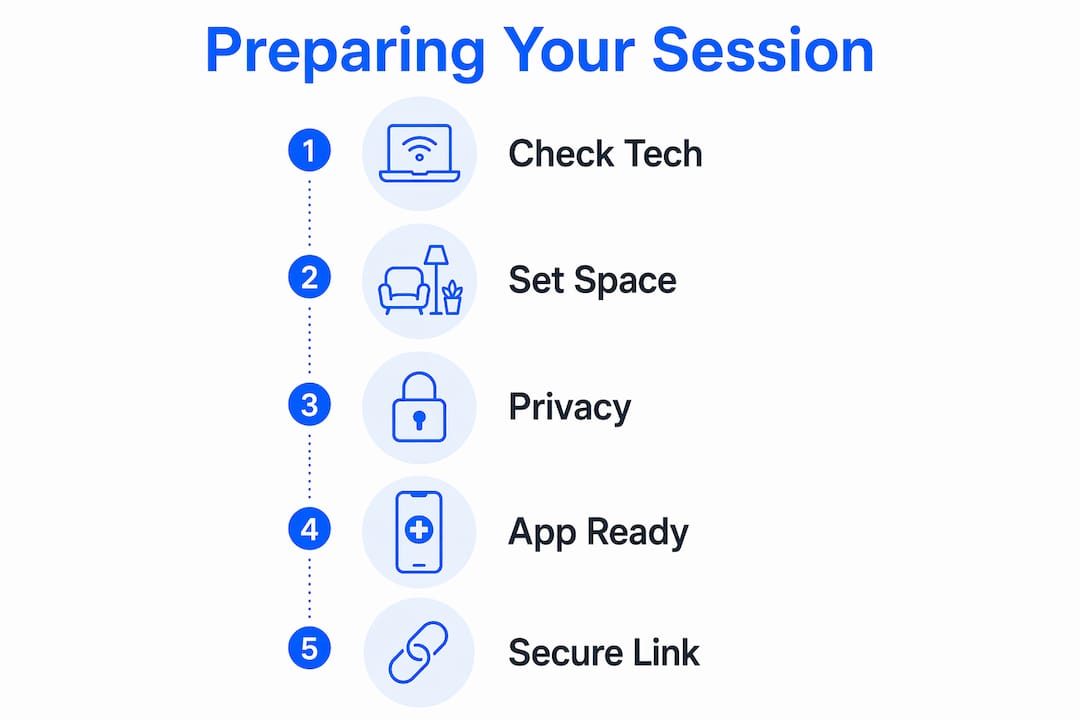
Privacy deserves special attention. Close the door, use headphones if others are nearby, and silence notifications on your device. If you share a home and privacy is limited, consider sitting in a parked car or a quiet outdoor space.
Pro Tip: Download the required app or platform the day before your appointment, not five minutes before. Log in once to confirm your credentials work so you are not troubleshooting at the start of your session.
Most platforms send a secure link via confirmation email or text before your appointment. Keep that message accessible so you can join with one click at the scheduled time.
How does the booking process work for a first-time telehealth visit?
Booking a remote counseling first time is straightforward on most platforms. You schedule online, by phone, or through a provider’s patient portal. After booking, you receive a confirmation email or text with a secure video link and instructions for joining.
Here is the typical sequence from booking to session end:
- Choose a provider based on specialty, availability, and insurance acceptance.
- Complete intake forms online before your appointment, covering medical history, current symptoms, and insurance details.
- Receive a secure video link via email or text.
- Log in 5–10 minutes early to test your connection.
- Join the session at the scheduled time and meet your provider.
- Discuss your history, current concerns, and treatment goals.
- Receive a follow-up plan, including next steps, referrals, or a prescription if appropriate.
Payment and billing are handled before or immediately after the session. Most platforms accept major insurance, Medicare, Medicaid, and health savings accounts. If you are paying out of pocket, confirm the self-pay rate when you book.
You are not expected to share everything in one session. Therapy progresses at a pace that you control, and your provider creates a supportive, non-judgmental space from the start. The first session is about establishing comfort and safety, not solving every problem at once.
How do you communicate effectively in your first online therapy session?
Effective communication in a virtual mental health appointment starts before you log on. Writing down two or three topics or concerns in advance gives you a reference point if nerves make it hard to think clearly in the moment. Preparation reduces pre-session jitters and helps you connect with your therapist more quickly.
A few practices that make a real difference:
- Be honest about your comfort level. If a question feels too personal, say so. A good therapist will adjust.
- Speak at your own pace. Silence is acceptable. You do not need to fill every pause.
- Name your feelings directly. “I feel anxious about being here” is useful information for your provider.
- Ask questions. If you do not understand a term or a next step, ask for clarification.
- Mention your goals. Even a vague goal, like “I want to feel less overwhelmed,” gives your provider direction.
The American Psychological Association confirms that telepsychology is effective for anxiety, depression, trauma, and relationship concerns. Some clients actually open up more easily in their own environment than they would in a clinical office. Your home setting can work in your favor.
Pro Tip: After your session, write down two or three things you want to remember or follow up on. Your memory of the conversation will fade quickly, and those notes become useful context for your next appointment.
What should you do when technical problems or nerves hit?
Technical problems during a teletherapy session are common and manageable. The key is having a plan before they happen rather than scrambling in the moment.
- If your video drops, rejoin using the same secure link. Most platforms allow instant re-entry.
- If your internet fails, switch to your phone’s mobile data or call your provider directly on the backup number you confirmed before the session.
- If audio cuts out, turn off your video to reduce bandwidth demand, or switch to phone audio while keeping the video platform open.
Having a backup device or phone number ready before the session starts is the single most effective way to minimize disruption. Share that backup number with your provider at the start of the call.
Nerves are equally common and equally manageable. Feeling anxious before your first virtual mental health appointment does not mean something is wrong. It means you are doing something new.
“You are not expected to have everything figured out before your first session. Showing up is the hardest part, and your provider knows that.”
If anxiety feels overwhelming before you log on, try a few slow breaths, step outside briefly, or remind yourself that your provider has guided hundreds of first-time clients through this exact moment. Rescheduling is also an option. Contact your provider’s office directly if you need to move your appointment, and most platforms allow cancellation within a set window without a fee.
How does pricing and insurance work for telehealth mental health visits?
Cost is one of the most common reasons people delay mental health care. Understanding the numbers upfront removes that barrier.
| Payment Type | Typical Cost |
|---|---|
| Uninsured / Self-Pay | $100–$225 per session |
| Insurance Copay | Varies by plan; often $20–$50 per visit |
| Medicare / Medicaid | Covered under most telehealth mental health services |
| Health Savings Account (HSA) | Accepted by most major platforms |
Session fees for uninsured patients typically fall between $100 and $225. That range reflects differences in provider type, specialty, and session length. Platforms that accept insurance bill your insurer directly, and you pay only your standard copay.
For a detailed breakdown of what your specific plan covers, the Helloklarity guide on telehealth insurance coverage explains what every major plan actually covers in 2026. If you carry Blue Cross Blue Shield, the Helloklarity resource on BCBS telehealth benefits covers the specifics for that plan.
Billing typically occurs through a secure payment portal before or immediately after your session. Keep your insurance card and a payment method accessible when you book.
Key takeaways
Your telehealth mental health first visit is an intake session focused on introductions, history, and goals, not deep therapeutic work, and preparing your tech, space, and questions in advance makes the biggest difference in how it goes.
| Point | Details |
|---|---|
| First visit is an intake | Expect introductions, history review, and goal-setting rather than active therapy. |
| Session length is 45–60 minutes | Some comprehensive evaluations extend to 80 minutes for a full assessment. |
| Tech setup matters | Test your camera, mic, and internet 10–15 minutes before the session starts. |
| You control the pace | You are not required to share everything at once; therapy moves at your comfort level. |
| Cost varies by coverage | Self-pay rates run $100–$225; insurance, Medicare, and HSAs are widely accepted. |
What i have learned after watching hundreds of first sessions
By Guorui
The biggest misconception I see is that people think they need to arrive at their first session with a clear diagnosis or a well-organized story. They do not. Providers are trained to draw out what they need through conversation. The intake process is designed for people who do not yet have the words for what they are experiencing.
What actually predicts a good first session is not preparation of content. It is preparation of environment and mindset. The clients who set up their space, test their tech, and write down one or two honest concerns tend to leave the session feeling heard. The ones who wing it often spend the first ten minutes distracted by logistics.
One thing most articles skip: the therapeutic relationship starts forming in the first five minutes. How your provider responds to your nervousness, how they explain confidentiality, whether they ask follow-up questions rather than just checking boxes. These signals tell you whether this is the right fit. Pay attention to them. If something feels off, you are allowed to try a different provider. That is not failure. That is good self-advocacy.
Telepsychology, the clinical term for therapy delivered via technology, has strong research backing from the American Psychological Association for conditions including anxiety, depression, and trauma. The format works. What you bring to it matters more than the screen between you and your provider.
— Guorui
Ready to book your first telehealth mental health appointment?
Helloklarity connects you to a network of over 1,000 licensed providers, including MDs, nurse practitioners, and therapists, with same-day availability in most cases. If you are managing anxiety, ADHD, depression, or another mental health concern, you can see a provider within 24 hours. Self-pay options start at $49, and Helloklarity accepts major insurance plans and health savings accounts.
Browse available telehealth services to find the right fit for your needs, or explore conditions treated on the platform to confirm your concern is covered. Booking takes minutes, and your first session could happen as soon as today.
FAQ
How long does a telehealth mental health first visit last?
Most initial telehealth consultations run 45–60 minutes. Comprehensive evaluations can extend to 80 minutes depending on the provider and the complexity of your history.
Do i need special software for a virtual mental health appointment?
Most platforms require you to download an app or access a secure video link sent by your provider. Test the platform at least 10 minutes before your session to avoid delays.
What if i feel too nervous to talk during my first online therapy session?
Nervousness is normal and expected. Therapists are trained to work with clients who feel anxious or unsure, and you are not required to share more than you are comfortable with in the first session.
Does insurance cover telehealth mental health services?
Most major insurance plans, including Medicare and Medicaid, cover telehealth mental health services. Copays vary by plan, and self-pay rates typically range from $100 to $225 per session for uninsured patients.
Can i switch providers if my first teletherapy session does not feel like a good fit?
Yes. Choosing a different provider is a normal part of finding the right therapeutic relationship. Contact your platform’s support team to request a new provider without losing your place in the system.
Recommended
- Online Psychiatrist For Depression: What To Expect And How To Get Started
- What Is A Telehealth Visit? How It Works, What It Costs, And How To Start | Klarity Health, Inc
- Online Primary Care Visit Best Practices In 2026
- Online Therapy: What It Is, How It Works, And What To Expect | Klarity Health, Inc
Get expert care from top-rated providers
Find the right provider for your needs — select your state to find expert care near you.
Related posts


— Monday to Friday, 7:00 AM to 4:00 PM PST
Join our mailing list for exclusive healthcare updates and tips.

— Monday to Friday, 7:00 AM to 4:00 PM PST