 HSA & FSA accepted; best-value for top quality care
 Same-day mental health, weight loss, and primary care appointments available

 Accept major insurances and cash-payHSA & FSA accepted; best-value for top quality careSame-day mental health, weight loss, and primary care appointments availableAccept major insurances and cash-pay
Direct Primary Care Model Explained: Benefits and Costs
Written by Klarity Editorial Team
Published: Jun 26, 2026

Direct primary care (DPC) is a membership-based healthcare model where patients pay a flat monthly fee directly to their physician for unlimited primary care services, bypassing insurance billing entirely. The model has grown sharply: over 3,000 DPC practices now operate across the U.S., and more than 7,200 employers offer DPC as an employee benefit. The American Medical Association supports DPC adoption as a path to reducing physician burnout and improving patient access. For patients tired of rushed appointments and surprise bills, understanding what the direct primary care model offers is the first step toward making a smarter healthcare decision.
What is the direct primary care model and how does it work?
The direct primary care model replaces insurance billing with a simple membership fee. Patients pay monthly or annually, and that fee covers unlimited primary care visits with no per-visit copays or deductibles. The physician gets paid directly, which eliminates the administrative back-and-forth with insurers that consumes a large portion of a traditional practice’s time.
DPC physicians limit their patient panels to roughly 600–800 patients, compared to 2,000–4,000 in a standard insurance-based practice. That smaller panel is what makes the rest of the model possible. Doctors have the time to actually know their patients.

Appointments typically last 30–60 minutes, and patients can usually get in the same day or the next day. Communication goes beyond the office visit. Most DPC practices offer access via phone, text, email, and telehealth, so patients can reach their doctor without scheduling a formal appointment for every question.
The core services covered by a DPC membership typically include:
- Annual wellness exams and preventive screenings
- Chronic disease management (diabetes, hypertension, thyroid conditions)
- Acute illness visits (infections, injuries, minor procedures)
- Mental health check-ins and medication management for primary care conditions
- Telehealth consultations and asynchronous messaging with your provider
Pro Tip: Confirm the full list of covered services with your DPC provider before enrolling. Some practices charge separately for labs, imaging, or in-office procedures even when the membership covers visits.
What are the direct primary care benefits compared to traditional care?
The primary value of DPC is removing the insurance middleman, which lets physicians focus on patient relationships and preventive care rather than billing codes. That shift changes the entire care experience.
Removing insurers from the billing process reduces administrative overhead by 10–20% of revenue. Physicians redirect that time and money toward patient care. The result is longer appointments, faster access, and a doctor who actually remembers your history.
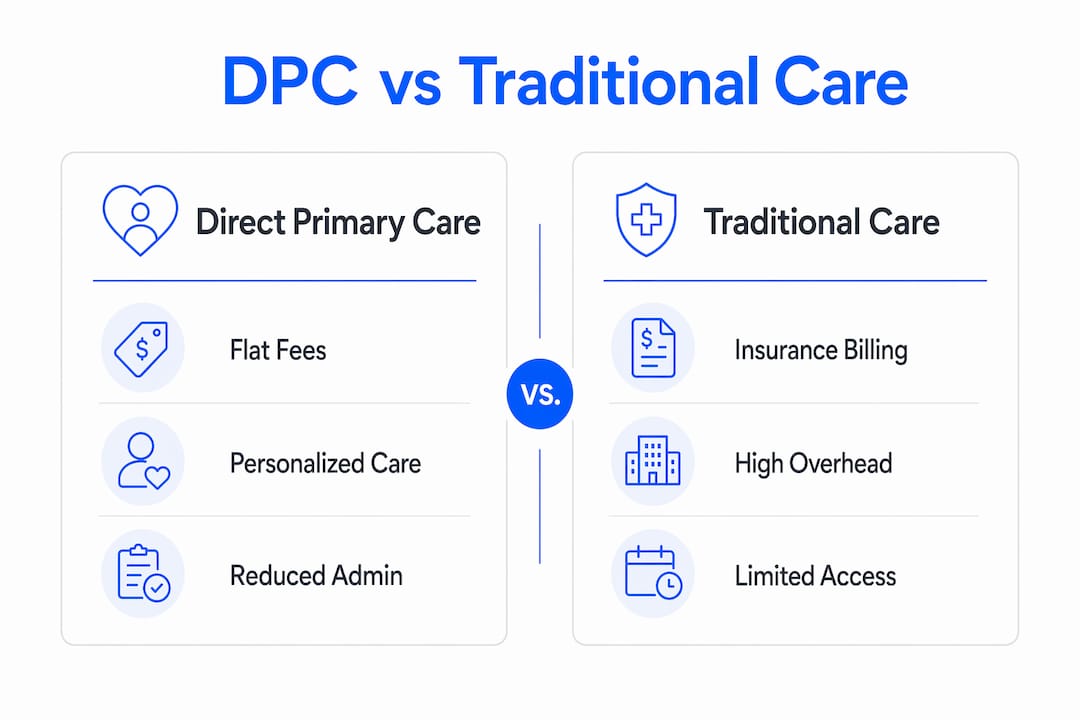
Physician burnout is a serious problem in traditional primary care. High patient volumes, insurance paperwork, and short appointment windows push many doctors out of the field. DPC practices report higher job satisfaction because physicians control their schedule and spend more time on medicine than administration.
For patients, the advantages of direct primary care include:
- Predictable costs. A flat monthly fee replaces unpredictable copays, deductibles, and surprise bills.
- Longer appointments. A 30–60 minute visit allows thorough evaluation rather than a 10-minute check-in.
- Same-day or next-day access. Small patient panels mean your doctor has room for you when you need care.
- Stronger patient-doctor relationship. Continuity of care improves outcomes for chronic conditions.
- Employer subsidy potential. Many employers now cover DPC memberships as part of their benefits package.
“DPC enables physicians to practice medicine the way they were trained to, with time, attention, and genuine continuity of care.”
DPC does have real limits. It does not cover specialist visits, emergency care, hospitalizations, or surgeries. Patients need separate insurance for those events. Think of DPC as covering the 80–90% of healthcare needs that are primary care, with insurance as the safety net for everything else.
Pro Tip: DPC works best for patients who use primary care regularly and want to avoid high-deductible surprises on routine visits. If you rarely see a doctor, run the numbers before committing to a monthly fee.
What does direct primary care cost, and is it affordable?
DPC is significantly more affordable than concierge medicine, which often charges $200–$500 per month for similar access. Monthly DPC fees range from $20–$50 for children and $50–$150 for adults, with family plans available at many practices. That pricing makes DPC accessible to a much wider range of patients than concierge models.
Some practices charge a one-time enrollment fee, typically $50–$100. Labs, imaging, and prescriptions are usually available at discounted wholesale rates rather than included in the membership. A DPC patient might pay $10 for a blood panel that costs $200 through traditional insurance billing.
| Service category | Typical DPC cost | Typical traditional care cost |
|---|---|---|
| Monthly membership (adult) | $50–$150 | No equivalent (copays per visit) |
| Office visit copay | $0 (included) | $20–$50 per visit |
| Basic lab panel | $10–$30 (wholesale) | $100–$300 (billed to insurance) |
| Annual wellness exam | Included | $0–$150 depending on plan |
| Telehealth visit | Included | $50–$100 per visit |
A significant regulatory update affects payment flexibility. IRS 2026 guidance allows Health Savings Account (HSA) funds to pay DPC membership fees up to $150 per month for individuals and $300 per month for families. That change makes DPC more financially accessible for patients already using HSAs alongside high-deductible health plans.
Pro Tip: Verify your HSA eligibility for DPC fees directly with your account administrator. Not all HSA accounts automatically reflect the 2026 IRS update, so confirm before using those funds.
What types of direct primary care practices exist?
Not all DPC practices operate the same way. The American Medical Association identifies three main types: pure DPC, hybrid DPC, and on-site DPC. Knowing which type you are joining affects your billing experience and insurance needs.
Pure DPC practices accept no insurance at all. Revenue comes entirely from membership fees. This model offers the cleanest billing experience and the most transparent pricing. Patients pay their monthly fee and nothing else for covered services.
Hybrid DPC practices collect membership fees but also bill insurance for some services. Patients may still encounter deductibles or copays for certain visits or procedures. This model can complicate the cost picture, so patients should ask exactly which services trigger insurance billing.
On-site DPC practices operate within large corporations and serve employees exclusively under a contract between the employer and the practice. Employees typically pay nothing out of pocket because the employer covers the membership cost. This model is growing as employers look for ways to reduce healthcare spending while improving workforce health.
The type of practice matters for your planning:
- Pure DPC requires you to maintain separate insurance for non-primary care needs.
- Hybrid DPC may reduce your out-of-pocket costs on some services but adds billing complexity.
- On-site DPC is only available through your employer and may not follow you if you change jobs.
Understanding types of primary care services available in each model helps you ask the right questions before signing up.
How does DPC fit with traditional insurance coverage?
DPC is not health insurance. Patients need separate coverage for hospitalizations, emergency room visits, specialist care, and surgeries. DPC handles primary care; insurance handles everything else.
The most common pairing is a DPC membership with a high-deductible health plan (HDHP). HDHPs carry lower monthly premiums because they cover only major medical events. DPC fills the gap by covering routine and preventive care at a predictable flat rate. Together, the two provide full coverage at a lower total cost than a traditional low-deductible plan for many patients.
The 2026 IRS HSA ruling strengthens this combination. Patients can use HSA funds to pay DPC fees, then draw on the same HSA for any large medical expenses that exceed their HDHP deductible. That creates a tax-advantaged way to cover both layers of care. Patients should verify insurance and telehealth coverage details with their specific plan to avoid gaps.
Situations where insurance remains necessary alongside DPC:
- Emergency room visits and hospitalizations
- Specialist referrals (cardiology, orthopedics, oncology)
- Surgical procedures and anesthesia
- Prescription drugs not covered by the DPC membership
- Mental health services beyond primary care scope
Key Takeaways
The direct primary care model delivers better access and lower routine costs by replacing insurance billing with a flat membership fee, but patients still need separate insurance for major medical events.
| Point | Details |
|---|---|
| Flat fee replaces billing | Monthly fees of $50–$150 cover unlimited primary care visits with no copays. |
| Smaller panels, better access | DPC doctors see 600–800 patients, enabling same-day appointments and 30–60 minute visits. |
| Three practice types exist | Pure, hybrid, and on-site DPC differ in how they handle insurance and billing. |
| Insurance is still required | DPC does not cover emergencies, specialists, or hospitalizations. |
| HSA funds now apply | 2026 IRS guidance allows HSA payments for DPC fees up to $150/month individual. |
Why DPC is worth serious consideration, but not for everyone
I have spent years watching patients cycle through rushed 10-minute appointments, only to leave with unanswered questions and a stack of bills they did not expect. DPC solves that specific problem better than any other model I have seen at this price point.
The patients who benefit most are those with one or two chronic conditions, families with young children who need frequent primary care, and self-employed individuals who want predictable healthcare costs. For those groups, DPC is not just convenient. It is genuinely better medicine.
The model has real weaknesses, though. Low-income patients often cannot absorb a monthly fee even at $50, especially when they also need to maintain insurance. Physician recruitment into DPC is still limited in rural areas, so geographic access is uneven. And hybrid practices can blur the cost transparency that makes pure DPC so appealing.
The employer adoption trend is the most interesting development right now. When a company covers the DPC membership as a benefit, the model’s affordability barrier disappears entirely. Employees get better primary care access, and employers reduce downstream specialist and ER costs. That dynamic is pushing DPC into the mainstream faster than any regulatory change.
If you are evaluating DPC, ask three questions before committing: Does the practice type match your billing preferences? Does the covered service list match your actual health needs? And does the math work when you add your HDHP premium to the monthly membership fee? If all three answers are yes, DPC is likely the right move.
— Guorui
Helloklarity’s approach to accessible primary care
The principles behind DPC, fast access, affordable pricing, and a direct relationship with your provider, are exactly what Helloklarity built its telehealth platform around. Helloklarity connects patients with over 1,000 licensed providers for primary care, mental health, and weight loss, with appointments available within 24 hours and self-pay options starting at $49.
Whether you are exploring DPC as your primary care solution or looking for a complement to your existing coverage, Helloklarity offers a flexible, affordable way to access licensed providers without the wait. The platform accepts major insurance and health savings accounts, making it a practical option for patients at every coverage level. Browse available telehealth services to find the right care for your needs, or find a provider in your state to get started today.
FAQ
What is direct primary care in simple terms?
Direct primary care is a healthcare model where patients pay a flat monthly fee to their doctor for unlimited primary care services, with no insurance billing for routine visits.
How much does a direct primary care membership cost?
Monthly fees typically range from $20–$50 for children and $50–$150 for adults, according to the American Academy of Family Physicians. Family plans are available at many practices.
Does direct primary care replace health insurance?
No. DPC covers primary care only. Patients need separate insurance for emergencies, specialist visits, hospitalizations, and surgeries.
Can I use my HSA to pay for direct primary care?
Yes. 2026 IRS guidance allows HSA funds to cover DPC fees up to $150 per month for individuals and $300 per month for families. Verify eligibility with your HSA administrator first.
Is direct primary care a good fit for families?
DPC works well for families with regular primary care needs because the flat fee covers unlimited visits for covered members. Children’s memberships are typically $20–$50 per month, making family plans cost-effective for households that use primary care frequently.
Recommended
- How Telehealth Cuts Your Out-of-Pocket Healthcare Costs
- Telehealth Primary Care Platform Features Explained
- Common Primary Care Conditions Treated Online: 2026 Guide
- Types Of Primary Care Telehealth Services In 2026
Get expert care from top-rated providers
Find the right provider for your needs — select your state to find expert care near you.
Related posts


— Monday to Friday, 7:00 AM to 4:00 PM PST
Join our mailing list for exclusive healthcare updates and tips.

— Monday to Friday, 7:00 AM to 4:00 PM PST